Welcome to the Mathematical World!
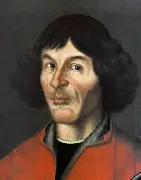
Nicholas Copernicus (1473 – 1543)
Father of the Heliocentric Model
Copernicus is best known for proposing the heliocentric model, placing the Sun at the center of the universe instead of Earth. While his contributions lie mostly in astronomy, his mathematical calculations were critical for explaining planetary motion, laying the groundwork for Johannes Kepler and Isaac Newton.
In his major work, De revolutionibus orbium coelestium (On the Revolutions of the Celestial Spheres, 1543), Copernicus mathematically described a system where the Earth rotates on its axis and orbits the Sun. His formulation replaced the ancient Ptolemaic geocentric model with equations better aligned to observations. For example, instead of explaining retrograde motion with complex epicycles, Copernicus showed that it could be understood as a natural consequence of relative planetary motion.
Mathematically, his model placed the Earth’s orbit around the Sun as nearly circular: \[ r \approx \text{constant}, \quad \theta = \omega t, \] where \(\omega\) is the angular velocity. Though later refined by Kepler into elliptical orbits, \[ \frac{x^2}{a^2} + \frac{y^2}{b^2} = 1, \] Copernicus’s framework was the first step toward a mathematically testable astronomy.
By quantifying celestial motion, Copernicus introduced a new era where models could be proven or refuted, promoting precision and experimentation in science. His approach encouraged later astronomers to link mathematics directly with observation, leading to major advances in physics, mechanics, and engineering. The heliocentric model not only changed the scientific worldview but also reinforced the power of mathematical reasoning as a path to uncovering truths about nature.
Facts:
- Born in Toruń, Poland.
- Trained in law and medicine, but devoted himself to astronomy.
- Published On the Revolutions of the Celestial Spheres in 1543, the year of his death.
- Hesitated to publish due to church opposition and potential controversy.
- Influenced later scientists including Kepler, Galileo, and Newton.

All rights reserved by the Mathematical Unity
Contact: +8801400044645
Email: mathematicalhorse1453@gmail.com
Our Discord Server: Mathematical Unity [Ulus Riyadiyat]